Changelog

Changelog

Local-first notebooks, built from the ground up for mingling with agents. Here's how it gets better, release by release.

2.6

Outlines of the Railway

nteract 2.6 polishes design with a left rail, outlines, packaging selection, and improved markdown + TeX rendering.

  • Navigate long notebooks from a left-rail outline
  • Manage packages from the rail without turning dependencies into notebook cells
  • Switch cells between code and markdown from the context and main menus
  • Disable automatic code formatting when exact source layout matters
  • design
  • rail
  • markdown
Release notes →
2.5

[redacted] Secrets, Explorable DataFrames, Navigable Tracebacks

The nteract 2.5 release invites you to stop leaking credentials in notebooks, emit Arrow for rich data exploration, and jump from tracebacks to the cell that raised.

[redacted] Secrets, Explorable DataFrames, Navigable Tracebacks
  • Python errors render as navigable, structured tracebacks
  • Explorable DataFrames with interactive crossfiltering
  • Outputs scrub secret-looking environment values to [redacted env]
  • arrow
  • pretext
  • polars
  • pandas
Release notes →
2.4

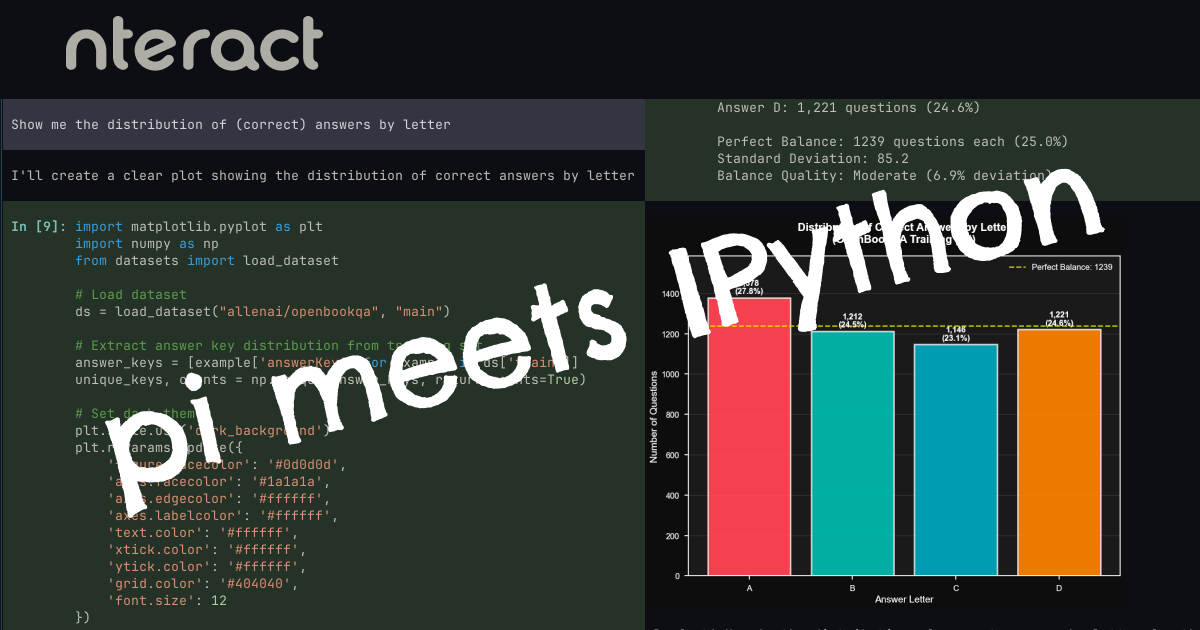
IPython REPL for Pi Agents

@runtimed/node opens the daemon behind the nteract desktop app to any Node runtime, and @nteract/pi uses it to give pi.dev agents a persistent Python REPL with notebook memory.

IPython REPL for Pi Agents
  • @runtimed/node exposes the runtimed daemon to Node: create notebooks, run cells, read outputs
  • @nteract/pi gives pi.dev agents a persistent, notebook-backed Python REPL, installed with pi install npm:@nteract/pi
  • Ask your pi agent to hack with @runtimed/node and build you what you need
  • node.js
  • agents
  • pi
  • runtimed
Release notes →
2.3

Environments That Find Themselves

Now nteract resolves environments from projects: pyproject.toml, environment.yaml, and pixi.toml. No more futzing with kernel definitions. Use your projects!

Environments That Find Themselves
  • Project files drive the kernel: pyproject.toml, pixi.toml, and environment.yml detected and used automatically
  • pixi joins uv and conda as a first-class environment manager
  • Prewarmed environment pools and captured-env caching
  • Native Intel Mac builds ship alongside Apple Silicon
  • Environments
  • Runtime
  • Desktop
Release notes →
2.2

Throwaway Runtimes, Conda Without the Restart

Agents spin up ephemeral runtimes that close when they finish, conda kernels pick up new packages without a restart, and the whole app gets a warm cream theme.

Throwaway Runtimes, Conda Without the Restart
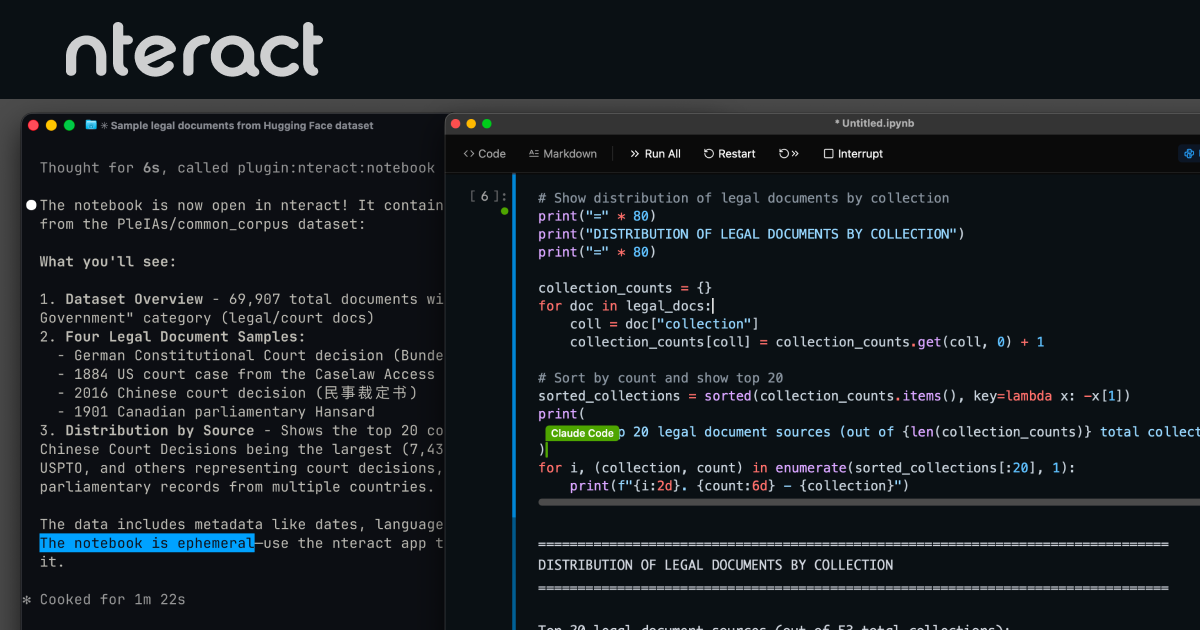
  • Ephemeral notebooks let agents grab a runtime on demand and throw it away when done
  • Conda kernels hot-sync new dependencies without a restart
  • Whole-app Cream theme
  • Agents
  • Environments
  • Notebook editing
  • Desktop
Release notes →
2.1

Outputs for Agents, Outputs for Humans

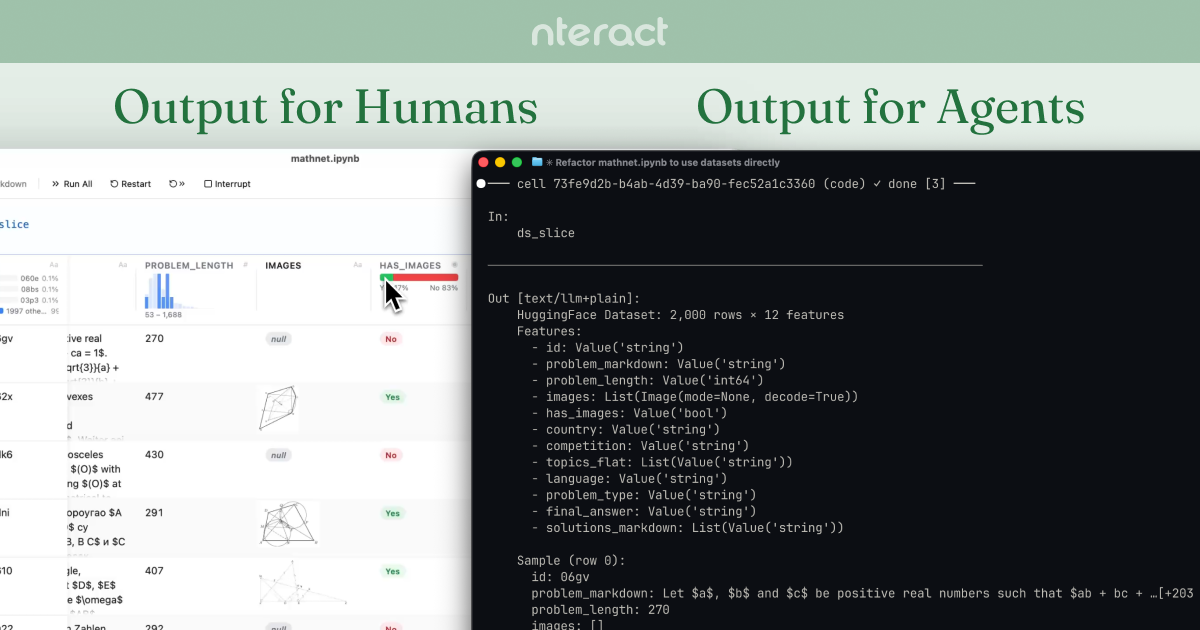
This is the first cut of repr-llm. Plotly, Vega, Leaflet, and more are supported for both humans and agent views. Native rendering for humans, text/plain+llm for agents.

Outputs for Agents, Outputs for Humans
  • Rich outputs synthesize a text/llm+plain summary for agents to read
  • An agent looking at a Plotly chart or GeoJSON map gets a description
  • Plotly, Vega, Leaflet, LaTeX, audio, video, and PDF all render natively
  • Preliminary Pixi support begins alongside uv and conda
  • Outputs
  • Agents
  • Environments
Release notes →